AI for Clinical Programming in R: What Works, What Doesn’t
Know exactly where an AI copilot saves you real time and where it will hand you a confident, wrong answer — then make the validate-before-use gate the thing that tells them apart
Pharma & Clinical
An honest capability map for using an AI copilot (Claude, ChatGPT, GitHub Copilot) in clinical trial R programming. See where it genuinely helps — drafting boilerplate admiral/xportr code, translating a written derivation, explaining a cryptic error, first-pass QC — and where it fails dangerously: hallucinating CDISC rules and controlled terminology, and silent logic errors like a default inner join that quietly drops rows. A runnable demo lets an AI-drafted merge corrupt a safety-population denominator, then an independent QC gate with diffdf catches it. The principle: AI-drafted code is unqualified until it passes the same validation gates a human’s must — AI changes the speed of the first draft, never the accountability.
TipKey takeaways
- An AI copilot is a fast drafter, not a validated author. It can turn a spec into R code in seconds — but a submission is a GxP deliverable (the “good practice” quality regulations: GCP, GMP, GLP), and no draft carries validation status until a qualified human puts it through the same gates any code must pass.
- Use AI where a mistake is cheap to catch. Boilerplate, refactors, docstrings, error explanations, spec-to-code translation, and test scaffolds are low-risk, high-value uses — the review catches errors immediately.
- Distrust it where a mistake is a wrong number. Hallucinated CDISC rules and controlled terminology, the choice of statistical method, and silent logic errors (a default inner join,
NAhandling, a<vs<=boundary) produce plausible, confident, wrong output that a glance will not catch. - The demo below is the whole argument. An AI-drafted
merge()runs clean and silently understates every treatment arm’s safety count; an independent QC re-derivation anddiffdf()catch it. Running is not the same as correct. - AI changes speed, not accountability. The programmer and the sponsor remain answerable for every derived value. The gate does not move because the first draft came from a model.
Introduction
An AI copilot — an AI coding assistant such as Claude, ChatGPT, or GitHub Copilot — will draft clinical R code faster than you can type it. Ask for a per-arm subject count joining two datasets and you get a syntactically perfect answer in seconds. The temptation is obvious, and so is the trap: a clinical submission is a GxP deliverable (the “good practice” quality regulations — GCP, GMP, GLP), and “the code ran” was never the standard for putting a number in front of a regulator.
So the honest question is not “is AI good enough?” — it is “what can you actually trust it for, and what must you never take on faith?” This lesson answers that with a concrete capability map, a single governing principle, and a runnable demo where an AI-drafted line of code is quietly, dangerously wrong. It is the opening lesson of this series and the companion to an auditable AI SOP, the standard operating procedure that turns the principle here into a documented, prompt-to-approval workflow. Where that lesson gives you the governance, this one gives you the map — and shows you a bug the gate catches.
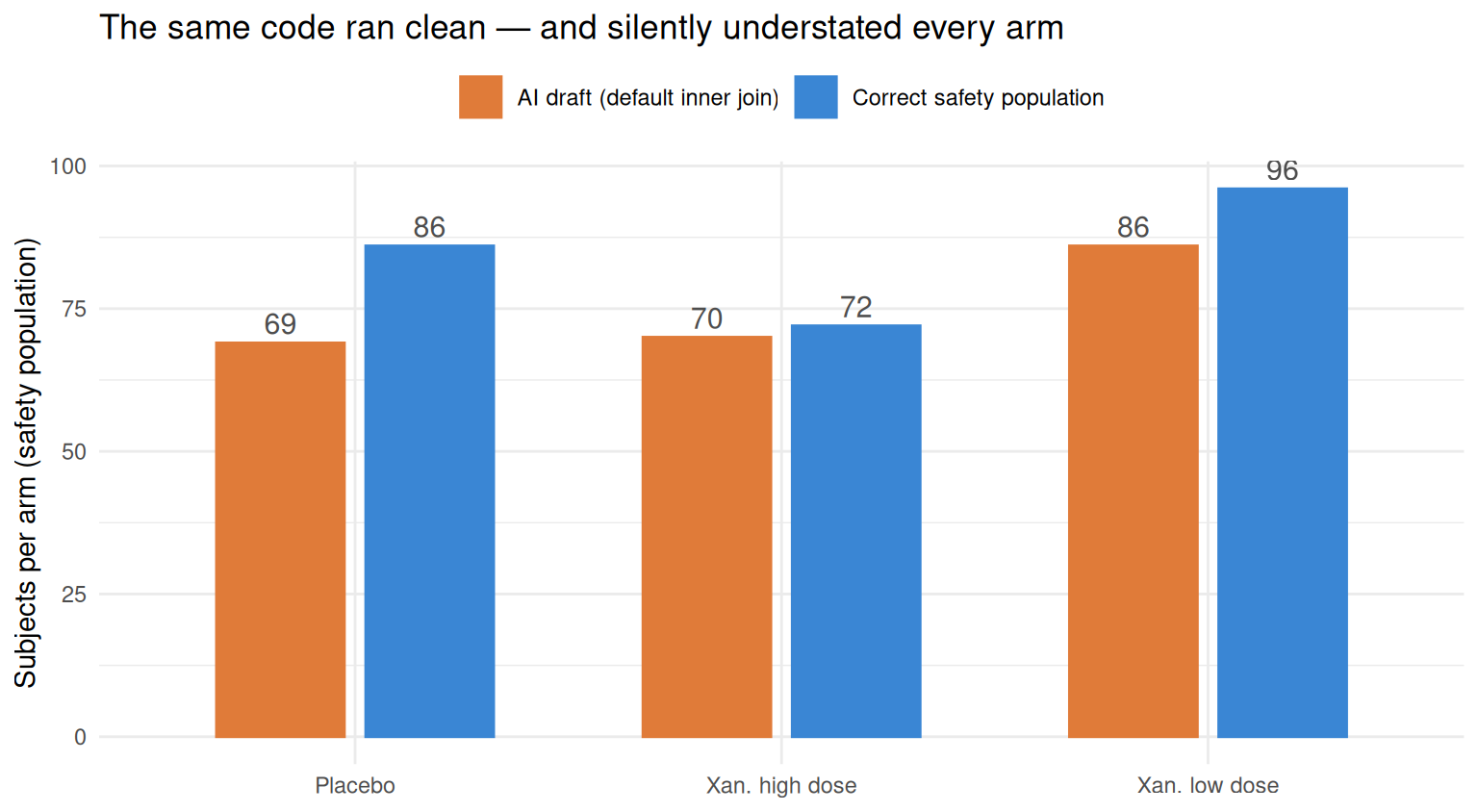
That gap is the lesson in one figure: the AI-drafted code produced the orange bars without a single error or warning, and every one is a wrong denominator for a safety table. We build it, catch it, and fix it below.
What AI is good at, and where it is dangerous
Start with an honest map. The split is not about how clever the model is — modern assistants write competent R. It is about residual risk: how badly a plausible-but-wrong draft hurts you if it slips through, and how cheaply you can catch it.
Strong uses — low residual risk, cheap to check
These are genuine time-savers. A mistake here is obvious or caught immediately by a read-through, so let the assistant do the typing.
| Where AI helps | Why it is a good fit | How you still check it |
|---|---|---|
Draft boilerplate admiral / xportr code from a written spec |
Repetitive, well-patterned code the model has seen thousands of times | Read it against the spec; run it |
| Translate a written derivation rule into R | Mechanical mapping from prose to code | Compare the code’s logic to the rule, line by line |
| Explain a cryptic error or someone else’s function | Fast, contextual, usually correct on common errors | Verify the fix actually resolves it |
Refactor, comment, and add roxygen documentation |
Cosmetic and structural — behaviour should not change | Re-run the tests; confirm output is unchanged |
| Scaffold unit tests and suggest QC checks | Gives you a starting skeleton to read and extend | Read every test; add the cases it missed by hand |
| First-pass code review — spot obvious smells | A cheap extra pair of eyes before a human review | Treat it as a hint, not a sign-off |
Weak, dangerous uses — high residual risk, plausibly wrong
Here the failure mode is not a crash you would notice; it is a confident, correct-looking answer that is wrong for your study. Be most skeptical exactly where the cost of being wrong is highest.
| Where AI is dangerous | Why it fails |
|---|---|
| Stating CDISC (Clinical Data Interchange Standards Consortium) rules from SDTMIG / ADaMIG (the SDTM — Study Data Tabulation Model — and ADaM — Analysis Data Model — Implementation Guides) | It will invent plausible standard rules and CT (controlled terminology) values with total confidence — and be wrong |
| Silent logic and edge-case errors | A default inner join that drops rows, mishandled NAs, a < where the spec says <= — the code runs and the number is quietly wrong |
| Fabricating function arguments or citations | It will call an argument that does not exist, or cite a guidance section that was never written |
| Confident-but-wrong on regulatory specifics | Dates, requirements, and “what the FDA requires” are exactly where hallucination is most costly and hardest to spot |
| Choosing a statistical method or model | A competent typist and a poor methodologist — it will recommend a plausible-but-inappropriate method for your design |
| Being accountable | It cannot review, cannot sign a validation record, and cannot answer for a wrong result — accountability never transfers to the tool |
The principle — what actually changes when AI drafts the code
Line the two columns up and the whole governance idea falls out: nothing about your validation changes. The draft has a new author; the gate is identical.
| The question the gate asks | The answer — identical whether AI or a human drafted it |
|---|---|
| Must a qualified human read and justify every line? | Yes. |
| Must it clear the same QC (quality control) gates — double programming, assertions, tests, reproducibility? | Yes. |
| Who is accountable for a wrong derived value? | The programmer and the sponsor — never the tool. |
| What does using AI actually change? | The speed of the first draft. Nothing else. |
Validate before use
That last table is the rule in one word: unqualified. AI-drafted code has no validation status of its own. It enters your process exactly where a junior programmer’s untested first draft would — as work to be reviewed, not a result to be trusted — and it earns validation only by clearing the same gates any code clears: a qualified human reviews and understands every line, then the code passes independent double programming, defensive assertions, a reproducible environment, and tests.
This is liberating, not restrictive. You do not need a special “AI validation methodology.” You need to route AI drafts through the QC discipline you already run — and, per an auditable AI SOP, to record that you did. The rest of this lesson makes the point concrete: a real AI-drafted line that runs perfectly and is dangerously wrong, and the gate that tells them apart.
The gate in action: catch a silent row-drop
Take a task an assistant handles constantly: report the number of subjects per treatment arm in the safety population, joining subject-level data to an “any adverse event” flag. We use public pharmaverse test data — the ADSL (the Subject-Level Analysis Dataset, one row per subject) and ADAE (the Adverse Events analysis dataset) from pharmaverseadam.
The AI drafts the obvious join with merge(). Watch the default.
library(pharmaverseadam)
data("adsl", package = "pharmaverseadam")
data("adae", package = "pharmaverseadam")

# The safety population: SAFFL is the safety-population flag; TRT01A is the actual treatment arm
saf    <- adsl[adsl$SAFFL == "Y", c("USUBJID", "TRT01A")]

# An "any adverse event" flag — one row per subject who had at least one AE
ae_any <- data.frame(USUBJID = unique(adae$USUBJID), ANYAE = "Y",
                     stringsAsFactors = FALSE)

# The AI-drafted line: a default merge() — which is a SILENT INNER JOIN
ai_merged <- merge(saf, ae_any, by = "USUBJID")
ai_counts <- as.data.frame(table(TRT01A = ai_merged$TRT01A))
names(ai_counts)[2] <- "N"
ai_counts
TRT01A N
1 Placebo 69
2 Xanomeline High Dose 70
3 Xanomeline Low Dose 86cat("Safety population (ADSL, SAFFL=Y):", nrow(saf), "subjects\n")Safety population (ADSL, SAFFL=Y): 254 subjectscat("Rows after the AI merge: ", nrow(ai_merged), "subjects\n")Rows after the AI merge: 225 subjectscat("Silently dropped by inner join: ", nrow(saf) - nrow(ai_merged), "subjects\n")Silently dropped by inner join: 29 subjectsRead the output. The code ran without error, produced a clean per-arm table, and is wrong. merge() defaults to an inner join, so it kept only the safety subjects who appear in the adverse-event data — silently dropping the 29 subjects who had no adverse event. Those subjects belong in the safety population’s denominator; the AI’s counts (69, 70, 86) understate every arm. Nothing flagged it. There is no error to see, no warning to heed — just a plausible table with the wrong numbers behind a safety analysis.
Now the gate. An independent QC programmer, working from the same intent, re-derives the counts with an explicit left join — keeping every safety subject and filling a missing flag with "N" — then compares the two tables with diffdf(), the double-programming engine from earlier in this series.
library(pharmaverseadam)
library(diffdf)
data("adsl", package = "pharmaverseadam")
data("adae", package = "pharmaverseadam")

saf    <- adsl[adsl$SAFFL == "Y", c("USUBJID", "TRT01A")]
ae_any <- data.frame(USUBJID = unique(adae$USUBJID), ANYAE = "Y",
                     stringsAsFactors = FALSE)

# The AI draft again (the default inner join) ...
ai_counts <- as.data.frame(table(TRT01A = merge(saf, ae_any, by = "USUBJID")$TRT01A))
names(ai_counts)[2] <- "N"

# ... vs an independent QC re-derivation with an explicit LEFT join
qc_merged <- merge(saf, ae_any, by = "USUBJID", all.x = TRUE)
qc_merged$ANYAE[is.na(qc_merged$ANYAE)] <- "N"
qc_counts <- as.data.frame(table(TRT01A = qc_merged$TRT01A))
names(qc_counts)[2] <- "N"

# The gate: compare the two per-arm counts on the treatment-arm key
diffdf(ai_counts, qc_counts, keys = "TRT01A")
Differences found between the objects!
Summary of BASE and COMPARE
====================================
PROPERTY BASE COMP
------------------------------------
Name ai_counts qc_counts
Class data.frame data.frame
Rows(#) 3 3
Columns(#) 2 2
------------------------------------
Not all Values Compared Equal
=============================
Variable No of Differences
-----------------------------
N 3
-----------------------------
=================================================
VARIABLE TRT01A BASE COMPARE
-------------------------------------------------
N Placebo 69 86
N "Xanomeline High Dose" 70 72
N "Xanomeline Low Dose" 86 96
-------------------------------------------------diffdf() reports three differences in N — one per arm. The AI draft (labelled BASE) undercounts every arm against the correct safety population (COMPARE): 69 vs 86, 70 vs 72, 86 vs 96. Neither a clean run nor a quick eyeball caught it; the independent gate did. That is the entire argument in one output: running is not the same as correct, and the gate is what tells them apart.
Fix the join and the gate confirms it:
library(pharmaverseadam)
library(diffdf)
data("adsl", package = "pharmaverseadam")
data("adae", package = "pharmaverseadam")

saf    <- adsl[adsl$SAFFL == "Y", c("USUBJID", "TRT01A")]
ae_any <- data.frame(USUBJID = unique(adae$USUBJID), ANYAE = "Y",
                     stringsAsFactors = FALSE)

# The fix: an explicit LEFT join keeps every safety subject
ai_fixed <- merge(saf, ae_any, by = "USUBJID", all.x = TRUE)
ai_fixed$ANYAE[is.na(ai_fixed$ANYAE)] <- "N"
fixed_counts <- as.data.frame(table(TRT01A = ai_fixed$TRT01A))
names(fixed_counts)[2] <- "N"

# The independent QC counts, re-derived
qc_merged <- merge(saf, ae_any, by = "USUBJID", all.x = TRUE)
qc_merged$ANYAE[is.na(qc_merged$ANYAE)] <- "N"
qc_counts <- as.data.frame(table(TRT01A = qc_merged$TRT01A))
names(qc_counts)[2] <- "N"

diffdf(fixed_counts, qc_counts, keys = "TRT01A")
No issues were found!“No issues were found!” — the corrected derivation now matches the independent QC derivation exactly. Only at this point, with the code understood and the gate green, is the derivation qualified. The lesson is not that AI is untrustworthy; it is that trust is earned at the gate, the same way it is for any code. The runtime is the judge.
The frameworks: principle, not permission
No regulator has published a rule titled “how to use an AI copilot to write clinical code.” What exists are higher-level frameworks whose principles apply — and being precise about what each does and does not cover is itself part of not over-claiming.
The FDA’s draft AI framework — direction of travel, not a mandate for code assistants. In January 2025 the FDA issued its first draft guidance on AI in drug development, Considerations for the Use of Artificial Intelligence To Support Regulatory Decision-Making for Drug and Biological Products (the comment period closed in April 2025). Two things to be exact about: it is draft guidance — it proposes a risk-based credibility framework tied to a model’s context of use, it does not require one — and its subject is an AI model that produces evidence supporting a regulatory decision (for example, a model predicting a clinical endpoint), which is distinct from an AI assistant that drafts code a human then validates. What you borrow is the principle — validation effort proportional to risk, and a human answerable for the result — not a direct obligation.
GAMP 5 — validate the software tool, risk-based. The de-facto standard for computerized system validation (ISPE’s GAMP 5: A Risk-Based Approach to Compliant GxP Computerized Systems, 2nd Edition) frames validation as effort proportional to risk. An AI coding assistant is, in GAMP terms, a tool used to produce a deliverable; you assure the deliverable — the code — against its intended use with effort that matches its risk. ISPE’s dedicated GAMP Guide: Artificial Intelligence (2025) extends this to AI-enabled systems in GxP contexts.
The R Validation Hub — the same logic for R packages. The cross-industry R Validation Hub treats package trust as a risk-based activity: assess a component’s risk, then apply proportional evidence. AI-drafted R code is one more component to which you apply exactly that lens.
All three converge on the same moves: assess the risk, control it with proportional validation, and keep a human accountable. None of them says the code is trustworthy because an AI wrote it — and neither should you. To be blunt about the words that get misused: AI-assisted is not AI-validated. There is no “FDA-approved AI” for drafting your derivations, no accuracy percentage that qualifies its output, and no model whose code you may ship un-reviewed. AI changes the speed of the first draft. It changes nothing about who answers for the result.
🟢 With an AI agent
Ask Prova “I used an AI copilot to draft a per-arm safety count that joins ADSL to ADAE — how do I QC it so a silent inner join or a dropped population can’t corrupt the denominator?” — it answers grounded in this series’ validation lessons, with the runnable diffdf() double-programming and row-count checks you can try on the draft. The runtime is the judge. Ask Prova →
Common issues
“The code ran, so it’s fine.” This is the single most dangerous instinct with AI-generated code. Running without error means the syntax is valid, nothing more. The inner-join bug above ran perfectly and returned a tidy table with the wrong numbers. A clean run is the beginning of validation, never the end of it — only the gates (review, double programming, assertions, tests) qualify the output.
The AI states a CDISC rule or a controlled-terminology value with total confidence. An assistant will tell you the exact SDTMIG requirement, the correct CT codelist value, or the ADaMIG naming rule in a fluent, authoritative sentence — and be wrong, with no tell. Never take a standards or controlled-terminology claim from a model on faith; check it against the actual published implementation guide or codelist before it touches your code.
Silent logic errors that survive a casual look. The default inner join is one of a family: a < where the spec says <=, an unhandled NA that drops or mis-buckets a subject, a join key with duplicates that fans out rows. None of them crash. All of them produce a plausible answer. This is precisely why an independent re-derivation plus diffdf() — not a re-read of the same draft — is the check that catches them.
Frequently asked questions
NoteCan AI write clinical trial code?
Yes — as a drafting tool, not as a source of validated code. An AI copilot can draft R code for a clinical analysis (an admiral derivation, an xportr step, a QC check), but that draft is unqualified: a qualified human must review and understand every line, and the code must then pass the same validation gates any code passes — independent double programming, defensive assertions, reproducibility, and tests. Used that way it speeds up the drafting without weakening the validation.
NoteIs AI-generated code allowed in FDA submissions?
There is no rule that forbids it and none that blesses it. What matters is the same thing that always mattered: the analysis is validated and a qualified human is accountable for it. The FDA’s January 2025 draft AI guidance proposes a risk-based credibility framework, but it addresses AI models that produce evidence, not coding assistants — and it is draft, not final. For AI-drafted code, apply your usual computerized-system-validation and QC discipline to the code itself; the source of the first draft does not change what the submission requires.
NoteWhat can AI not do in clinical programming?
It cannot be accountable, and it cannot be trusted on anything it can state confidently but get wrong: CDISC/SDTMIG/ADaMIG rules and controlled-terminology values, the choice of statistical method for your design, and silent logic or edge-case errors (a default inner join, NA handling, a boundary < vs <=). It also cannot sign a validation record. Keep the method decision and every regulatory specific with a qualified human, and validate every draft before use.
NoteHow do I validate AI-generated R code?
Exactly as you validate any code — the source of the draft is irrelevant to the gate. A qualified programmer reads and justifies every line against the specification, then the code clears independent double programming (a second, separate derivation compared with diffdf()), defensive assertions, a reproducible environment, and tests. For a join like the one above, add a row-count reconciliation so a silently dropped population fails loudly instead of understating a denominator.
NoteDoes using AI change who is accountable?
No. Accountability never transfers to the tool. The programmer who used the assistant, and the sponsor, remain answerable for every derived value — just as they would be for code typed by hand. AI changes the speed of the first draft and nothing about who answers for the result.
Test your understanding
ImportantYour turn: name the gate that catches a silent row-drop
An assistant drafts a per-arm count of the safety population by joining a subject-level dataset to an “any AE” flag with a default merge(saf, ae_any, by = "USUBJID"). It runs cleanly and returns a tidy table. Unknown to you, the default inner join dropped every safety subject with no adverse event, understating each arm’s denominator.
- In prose: name the QC gate that would catch this before it ships, and explain why “the code ran” and “the table looks right” are not evidence it is correct.
- In R: build a tiny two-subject example where one subject has no matching AE flag, derive the AI version (default
merge()) and an independent QC version (all.x = TRUE,NAfilled to"N"), and use a row-count check plusdiffdf()to catch the discrepancy.
TipHint
The catching gate is independent double programming: a QC programmer re-derives the counts from the same intent with an explicit left join, then compares with diffdf(). A cheap first alarm is a row-count reconciliation — after the join, the number of rows should still equal the safety population; if it shrank, the join dropped subjects. “The code ran” only means the syntax is valid.
TipSolution
Step 1. The gate is independent double programming with diffdf(): a second programmer re-derives the per-arm counts from the same intent — using an explicit left join so every safety subject is kept — and compares the two tables. A row-count reconciliation is the cheap early warning: the joined data should still have one row per safety subject, so nrow(after) < nrow(saf) means the join silently dropped rows. “The code ran” means only that the syntax is valid; the inner-join version runs perfectly and is wrong for every subject who had no adverse event.
library(diffdf)

# Two safety subjects; subject 01-002 has NO adverse event
saf    <- data.frame(USUBJID = c("01-001", "01-002"), TRT01A = c("Placebo", "Placebo"))
ae_any <- data.frame(USUBJID = "01-001", ANYAE = "Y")   # only 01-001 had an AE

# AI draft: default inner join silently drops 01-002
ai <- merge(saf, ae_any, by = "USUBJID")
stopifnot(nrow(ai) == nrow(saf))   # FAILS — the row-count alarm fires

# Independent QC: explicit left join keeps every safety subject
qc <- merge(saf, ae_any, by = "USUBJID", all.x = TRUE)
qc$ANYAE[is.na(qc$ANYAE)] <- "N"

ai_counts <- as.data.frame(table(TRT01A = ai$TRT01A)); names(ai_counts)[2] <- "N"
qc_counts <- as.data.frame(table(TRT01A = qc$TRT01A)); names(qc_counts)[2] <- "N"
diffdf(ai_counts, qc_counts, keys = "TRT01A")   # Placebo: BASE 1 vs COMPARE 2
The stopifnot() row-count check fails immediately, and diffdf() flags the arm — the review then explains it, and the join is corrected before the derivation is qualified.
NoteQuick check: an AI-drafted join runs cleanly and returns a tidy per-arm table. What is its validation status?
A. Validated — it ran without error and the table looks right. B. Unqualified — until a human reviews it and it clears the QC gates (double programming, assertions, tests), it has no validation status. C. Validated, provided the assistant is a current, capable model.
TipShow answer
B. Running cleanly and looking right are not evidence of correctness — the inner-join draft did both and silently understated every denominator. AI output is an unqualified draft regardless of which model produced it (ruling out C); it earns validation only through human review plus the same QC gates any code must pass (ruling out A).
Conclusion
An AI copilot is a real accelerator for clinical R programming — as long as you are honest about the map. Use it where a mistake is cheap to catch: boilerplate, refactors, documentation, error explanations, spec-to-code translation, test scaffolds. Distrust it exactly where a mistake is a wrong number a glance will not catch: CDISC and controlled-terminology claims, the choice of statistical method, and silent logic errors like the default inner join above. Then hold the one line that makes any of it defensible — AI-drafted code is unqualified until a qualified human reviews it and it clears the same gates as any code. The demo said it plainly: the code ran, the table looked right, and an independent gate proved it wrong. AI changes the speed of the first draft. It changes nothing about who is accountable for the result. The runtime is the judge.
Note
This lesson is reproducible: the AI-drafted inner-join bug corrupting the safety-population counts, the diffdf() gate catching it, and the corrected left join passing all reproduce here on public pharmaverse data. Copy any block and run it to reproduce them. The AI drafting step happens in your own tooling; the R that validates the draft is real and executes. The runtime is the judge.
Reuse
Citation
BibTeX citation:
@online{2026,
  author = {},
  title = {AI for {Clinical} {Programming} in {R:} {What} {Works,}
    {What} {Doesn’t}},
  date = {2026-07-02},
  url = {https://www.datanovia.com/learn/pharma-clinical/08-agentic-clinical-programming/ai-capabilities-limits-clinical-programming},
  langid = {en}
}
For attribution, please cite this work as:
“AI for Clinical Programming in R: What Works, What
Doesn’t.” 2026. July 2. https://www.datanovia.com/learn/pharma-clinical/08-agentic-clinical-programming/ai-capabilities-limits-clinical-programming.